Quick answer
For most photos, use JPG quality 85-90%. Below 80% shows visible artifacts. Above 95% wastes file size with no visible benefit. The HEIC to JPG Converter default is 90%, which matches iPhone quality.
Every tool lets you choose JPG quality from 0-100%. Too low and you see blocking artifacts. Too high and the file stays huge. Most users guess wrong. Here is the science.
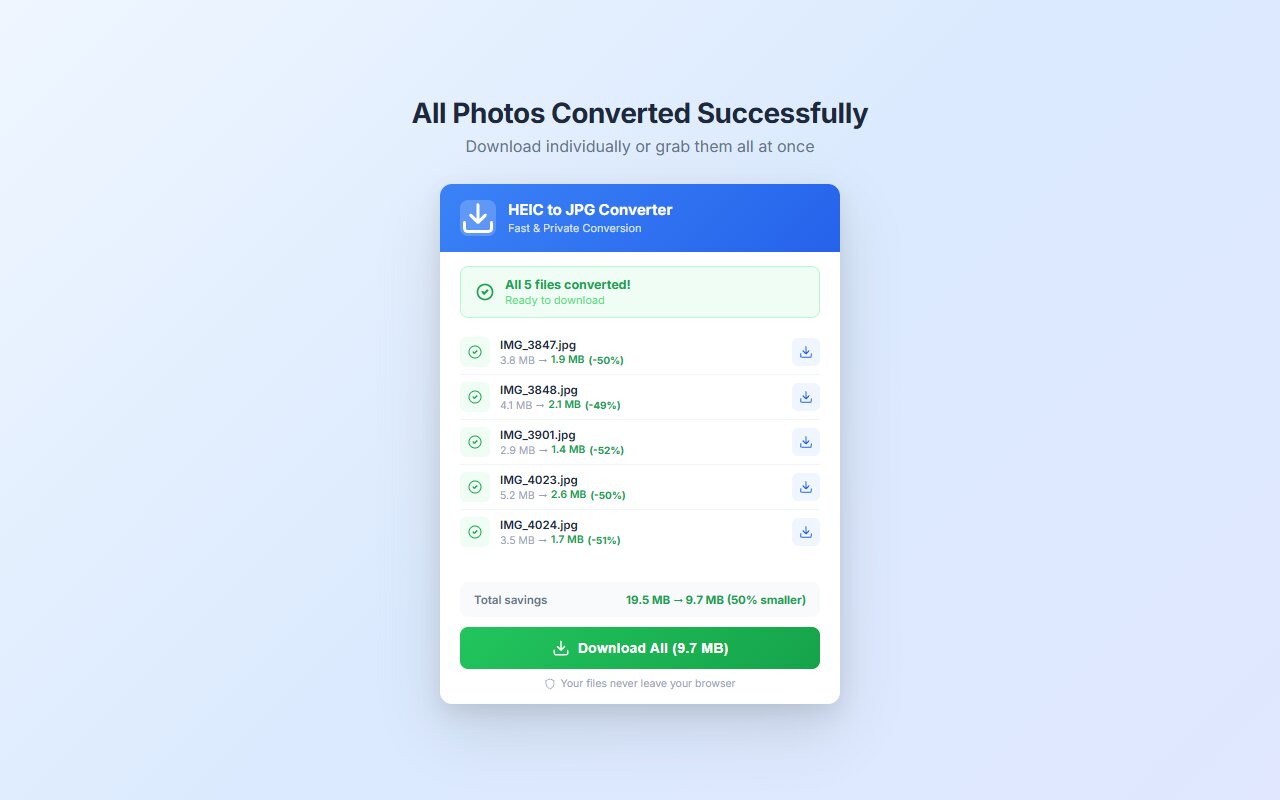
heicconvert.site · HEIC to JPG Converter
Drop HEIC files here
or click to choose . up to 200 at once
HEIC
IMG_4827.HEIC
Done . 0.9s
HEIC
IMG_4828.HEIC
Done . 1.1s
HEIC
IMG_4829.HEIC
82%
3 of 28 converted
0 uploaded
Quality scale explained
- 50%: Visible compression artifacts, blocking. Only for thumbnails.
- 70%: Minor artifacts visible on close inspection. Acceptable for email attachment.
- 85%: Artifacts imperceptible to human eye. Safe for web sharing (blog, social media).
- 90%: Near-lossless quality. Recommended default. iPhone uses this range.
- 95%+: Visually indistinguishable from lossless. File 30-50% larger for no visible benefit.
Quality vs file size
Converting 3 MB HEIC at different qualities: 85% = 1.8 MB, 90% = 2.4 MB, 95% = 3.2 MB, 100% = 3.5 MB. Sweet spot is 85-90%.
Different use cases
- Email: 70-75% (file size matters).
- Web sharing: 85% (balanced quality and size).
- Personal backup: 90% (default, recommended).
- Printing: 85-90% (print resolution masks compression artifacts).
- Professional archival: 95%+ (or PNG/TIFF for lossless).
How the extension handles quality
Defaults to 90%, lets you adjust 50-100% via slider. Drag left to reduce size, right for higher quality. Preview file size updates in real time. Default 90% is recommended.
At-a-glance comparison
| Quality % | Visual quality | File size vs HEIC | Best use |
|---|---|---|---|
| 50-70% | Poor (artifacts) | 30-40% smaller | Email only |
| 75-85% | Good (imperceptible) | 40-50% smaller | Web, social media |
| 90% (default) | Excellent | 30-35% smaller | All-purpose |
| 95%+ | Excellent | 0-10% smaller | Archival, printing |
Frequently asked questions
Why does HEIC at 90% match JPG at 95% quality?
HEIC codec is more efficient. It compresses better than JPG at lower quality levels.
Should I convert HEIC to 100% JPG quality?
No. JPG 100% is still lossy and larger than original HEIC. Use PNG or TIFF if you need lossless.
Can I re-compress a JPG without losing more quality?
No. JPG is lossy. Re-compressing loses more quality. Only compress once.
What quality should I use for printing?
85-90% is fine for prints (300 DPI). Print resolution masks compression artifacts.
Is there a way to convert HEIC to lossless without PNG?
Yes, TIFF format is lossless but 2-3x larger than JPG. PNG is smaller for lossless.